Publications

Some go deep. Some go wide. I go both.

Eight books spanning leadership, organizational change, behavioral science, markets and risk, AI adoption, and applied ethics.

Open-source research on AI adoption, leadership, and organisational change.

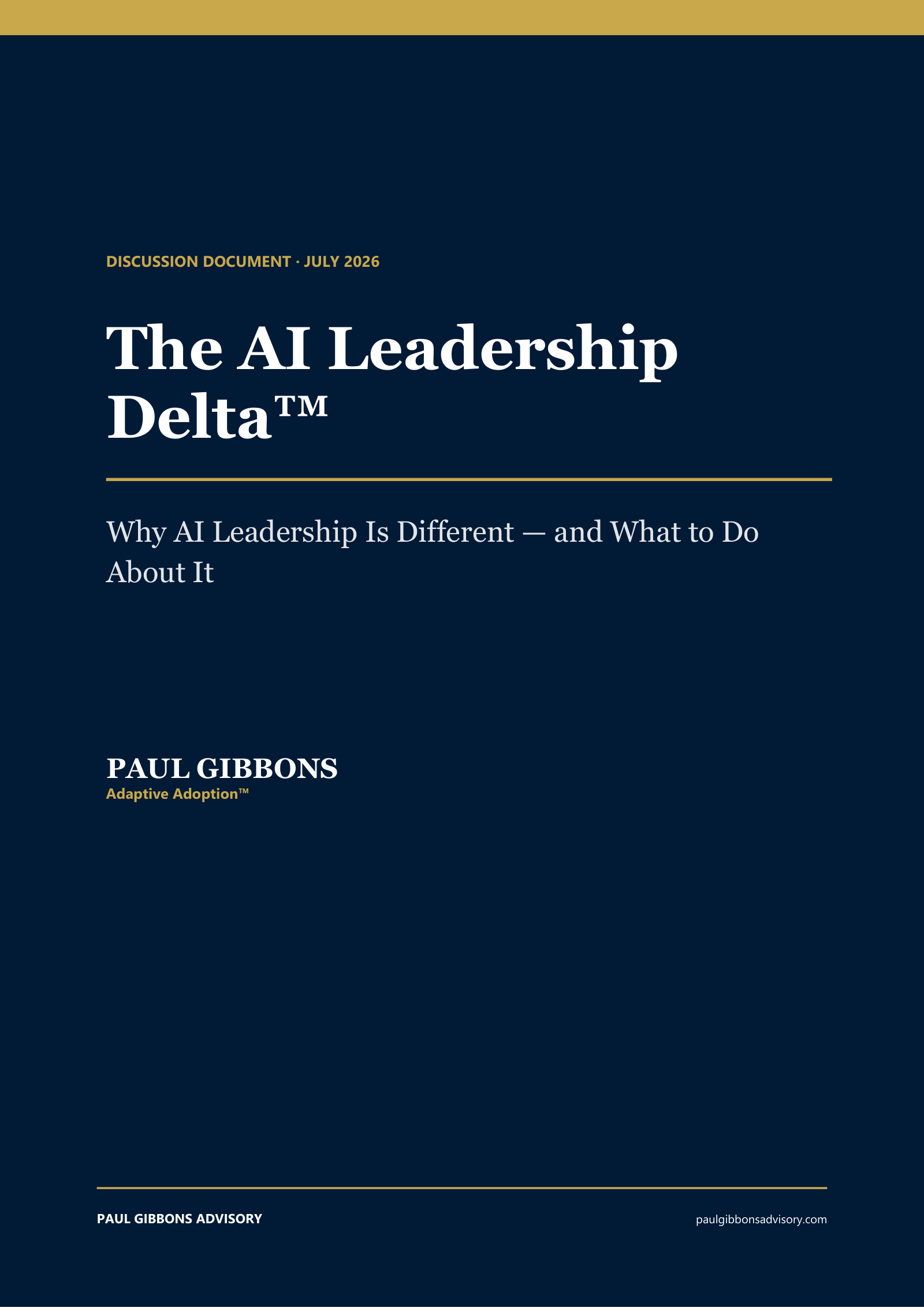
Change Management Was a Breakthrough — discussion document cover
Discussion Document — Beta

Change Management Was a Breakthrough. Is It Enough?

Orthodox Models, Modern Problems, and the Case for Something New

A discussion document examining where traditional change management still works — and why AI adoption, continuous disruption, and behavioural complexity demand something different.

Solve for Trust — RIST Framework cover
Discussion Document

Solve for Trust

The RIST Framework for AI Adoption

Why AI adoption stalls aren't technology problems — they're trust problems. A four-dimensional diagnostic for leaders navigating the intelligence transition.

Adopting AI book cover by Paul Gibbons

Adopting AI: The People-First Approach

Leading the Intelligence Transition

2025

AI adoption fails when organizations treat it as a technology rollout rather than a human transition. This book explores what happens when the smartest, strangest colleague you have ever had arrives at work — an intelligence that is unpredictable, opaque, and prone to bias. Paul and co-author Chris Healy present adaptive adoption: a bottom-up, experimental framework with ethics at its center. From boardrooms to courtrooms, laboratories to studios, the book maps AI's applications across contexts while maintaining balance between opportunity and risk throughout the intelligence transition.

The Science of Organizational Change book cover by Paul Gibbons

The Science of Organizational Change

Grounding Change in Behavioral Science

2015

Paul's best-known work and still selling strongly over a decade after publication. Ranked among the top five change management texts of all time, this book was the first to bring behavioral science to leadership and change. It integrates advances in mindfulness, behavioral economics, sociology, and complexity theory to provide evidence-based guidance for senior executives and change practitioners. The book examines cognitive biases underlying organizational failures from the 2008 financial crisis to Deepwater Horizon, introducing change-agility as the capability organizations need to become disruptors rather than the disrupted.

The Future of Change Management book cover edited by Paul Gibbons

The Future of Change Management

Volume I

2024

An edited volume asking whether 20th-century change management practices remain relevant amid people analytics, AI, neurodiversity, and mental health awareness. Contributions from leading practitioners at Google, Deloitte, and IBM are organized into three sections: Brains and Minds (neurodiversity, neuroscience, mental health), Behaviors (culture change, policy implementation), and Tools (evidence-based approaches, design thinking, people analytics, generative AI). The first of a planned three-volume series addressing frontier topics in contemporary change practice.

Change Myths book cover by Paul Gibbons and Tricia Kennedy

Change Myths

Critical Thinking for Change Professionals

2023

Co-authored with Tricia Kennedy, this book examines how myths become entrenched in organizational change practice despite contradicting contemporary research. From the debunked left-brain/right-brain creativity model to the Kubler-Ross grief curve inappropriately applied to business transformation, the book investigates why false frameworks persist and how to evaluate change models against current human sciences research. A pioneering application of critical thinking tools for human capital professionals.

The Spirituality of Work and Leadership book cover by Paul Gibbons

The Spirituality of Work and Leadership

Humanizing the Business of Leading

2020

The most comprehensive scholarly treatment of workplace spirituality to date. This book brings rigor to meaning-making, vocation, purpose, happiness, mindfulness, altruism, motivation, and engagement in organizational life. Drawing on psychology, philosophy, evolutionary biology, sociology, and systems thinking, it examines what spirituality actually is, how it differs from religion, and whether spiritual workplace experiences can be intentionally cultivated. Not self-help. Not woo. The serious evidence-based case for spiritual fit in the workplace.

Brains Bodies and Minds book cover by Paul Gibbons - The Great Collisions Volume 1

Brains, Bodies, and Minds

How AI Is Transforming Medicine, Therapy, and Wellness

2026

The first volume in The Great Collisions series. What happens when the intelligence explosion crashes into human systems? On the front line are doctors, biohackers, GLP-1 medications, wellness influencers, and therapists. This book is a strategic playbook for the revolution currently underway in medicine, therapy, and wellness — exploring whether AI is a good therapist, whether it is a better doctor than yours, what bodily autonomy and libertarian biology mean, and what the wellness-industrial complex gets right and wrong.

Impact book cover by Paul Gibbons

Impact

21st-Century Change Tools for Leaders

2020

With only 25 percent of digital transformations succeeding, leaders need current change methodologies grounded in behavioral science, complexity theory, agile methods, and information science. As workplaces become technologically advanced through AI and robotics, community, purpose, connection, empathy, relationships, and trust all gain significance. This book positions leadership as central to humanizing business and upskilling workforces, examining how understanding contemporary research and leveraging 21st-century learning technologies enables faster, more effective capability building.

The Great Collisions of 2026

Volume I

Brains, Bodies, Minds

Available Buy →
Volume II

Intelligent Enterprises

In progress
Volume III

Trustless Markets

In progress
Volume IV

Intelligence Frontiers

In progress
Volume V

Scientific Revolutions

Planned

A five-volume series exploring the collisions reshaping the world — where AI meets medicine, organizations meet intelligence, markets meet geopolitics, consciousness meets computation, and science meets its own boundaries.