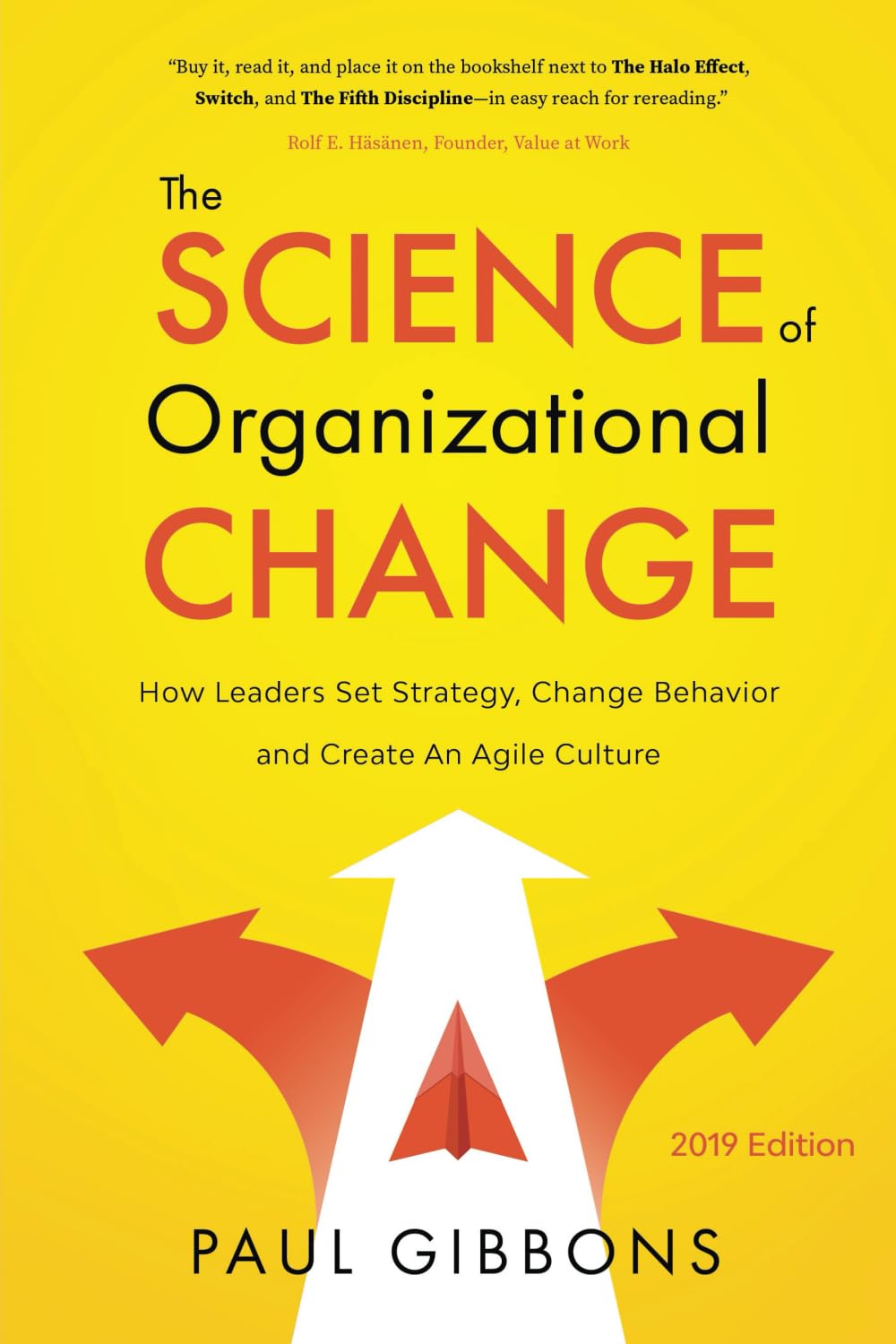
Why cognitive biases, change myths, and pop leadership are undermining your transformation — and what the evidence actually says.
One of the top-five change management books of all time.
— Change Management Review
Brings clarity and sense to a charlatan-filled domain.
— Jeffrey Pfeffer, Stanford University
Put it on the shelf next to Switch and the Fifth Discipline for easy re-reading.
— Rolf Hassenson
This is an ambitious book. Cataloguing the pseudoscience, half-truths and unvalidated approaches that are widely used is a herculean task.
— Koen Smets
From the myth of 70% failure rates to the science of behavior change — a complete rebuilding of change management on evidence-based foundations.
How bad is the change problem, really? Gibbons traces the "70% failure rate" myth to its source, debunks it, then introduces Change-Agility™ — the organizational capabilities that separate change masters from the rest.
Change-Agility™Six systematic flaws in how humans think about risk. The planning fallacy and consulting fictions. Decision-making in complex and ambiguous environments. Anti-fragility applied to organizational change.
Psychology of RiskWhy organizations are complex adaptive systems — and why linear, plan-driven change is fighting the wrong battle. Emergence, self-organization, and what Taleb's anti-fragility means for transformation.
ComplexityFolk psychology, pop psychology gurus, and why "everybody is an expert on people" is the most dangerous assumption in business. The neuroscience backlash and what actually works.
Pop LeadershipFrom behaviorism to neo-behaviorism — the cognitive backlash threw the behavioral baby out with the behaviorist bathwater. The evidence on what actually changes behavior in organizations.
Behavioral ScienceFrom antiscience to evidence-based management. The case for science-based leadership, epistemological humility, and the link between reason, science, and human flourishing.
Evidence-Based ManagementThese ideas didn't exist in the change management literature before this book introduced them. Paul Gibbons originated each one.
Change management should be euthanized — it has become a bureaucratic overlay that adds cost, adds delay, and subtracts leadership.
Paul Gibbons · The Science of Organizational Change
Available in Kindle, paperback, and hardcover.