The AI Leadership Delta™
Why AI Leadership Is Different — and What to Do About It
Abstract
Every generation of leadership scholarship responds to conditions its predecessors could not have anticipated. Burns wrote for post-industrial democratic leadership. Heifetz wrote for adaptive challenges. Kotter wrote for competitive urgency. Their models assumed technology remained an instrument. AI can now behave as a semi-autonomous actor, spans technical layers no executive can master alone, and creates ethical questions faster than most governance systems can answer them.
This produces a paradox. The relational axis of leadership — trust, psychological safety, and innovation climate — matters enormously because AI unsettles expertise, identity, and power. Relational excellence alone, however, does not prepare leaders for the strategic decisions AI demands: where to build or rent capability, how to sequence augmentation and automation, how to govern amid regulatory uncertainty, and how to hold a generational direction while capabilities change by the week.
The AI Leadership Delta™ addresses this paradox. It identifies six structural conditions that distinguish the AI moment, specifies seven observable and developable behavioural dimensions across three leadership domains (Lead Self, Lead Others, and Lead System), and connects them to a BUILD-first programme in which leaders construct useful AI systems before asking others to adopt them.
The delta has a double meaning: the gap between current leadership capability and what the moment requires, and the programme designed to close it. Existing models remain strong on relational leadership. They offer far less operational guidance for the strategic judgements created by fast-moving, probabilistic, and increasingly agentic technology.
Part I — The Leadership Model Proliferation Problem
Leadership studies have produced a crowded field of theories, models, and taxonomies. In leadership research I conducted during the 1990s, I identified nearly thirty “X-leadership” models: transformational, authentic, servant, integral, adaptive, and many more.
This raises three questions. Are all these models valid? Has X-leadership evolved as conditions have changed, or is each new X old wine in new bottles? And does the AI age require another X at all?
James MacGregor Burns gave us transformational leadership in 1978 — the distinction between leaders who trade (transactional) and leaders who transform. Bernard Bass operationalised it with the Full Range Leadership Model. Robert Greenleaf proposed servant leadership in 1970. Bill George championed authentic leadership in 2003. Ronald Heifetz distinguished technical from adaptive challenges in 1994. Daniel Goleman popularised emotional intelligence as the decisive leadership variable. Each model responded to the conditions of its era, and each contributed something real.
Those are the questions this paper addresses. The case for an AI Leadership Delta depends on showing that the operating conditions have changed enough to require capabilities that existing models, properly applied, do not supply.
The instinctive answer, especially from experienced practitioners, is that leadership is leadership. The skills that made a leader effective in 2010 — empathy, clarity, courage, vision — still matter in 2026. Context changes; leadership principles do not.
That position is half right.
The relational axis has become more urgent. AI threatens established expertise, raises contested ethical questions, and produces understandable anxiety. Trust, psychological safety, and innovation climate are operating conditions, not cultural decoration. BCG’s 2025 AI at Work survey found that the share of employees who felt positive about generative AI rose from 15 per cent to 55 per cent where leadership support was strong. McKinsey’s 2025 global survey found AI high performers three times more likely than their peers to report strong senior-leader ownership and commitment. The relational dimension is load-bearing.
The “leadership is leadership” position nevertheless misses something important. Relational capability creates necessary conditions; it does not supply the distinctive strategic capability. A leader may bring deep empathy, excellent communication, and strong psychological safety, yet still make poor choices about build-or-rent decisions, workforce sequencing, governance, and technology evaluation. They may fail graciously, with the full trust of their workforce, and the failure will be no less consequential.
The relational axis is the soil; the strategic axis is the crop. Without the soil, nothing grows. Soil alone, however, grows nothing in particular.
This paper argues that AI creates a strategic leadership dimension that established models only partly address, and that the resulting capability gap is specific enough to assess and develop.
Part II — Two Axes, One Gap
To understand what is genuinely different about AI leadership, it helps to map the territory that existing models occupy — and to name the territory they leave blank.
The Relational Axis
Most canonical leadership models cluster on what might be called the relational or social-emotional axis. Their primary concern is how leaders relate to followers, create meaning, build trust, and foster engagement.
Transformational leadership focuses on inspiration, intellectual stimulation, individualised consideration, and idealised influence. Servant leadership centres the leader’s obligation to serve followers’ development. Authentic leadership emphasises self-awareness, relational transparency, balanced processing, and internalised moral perspective. Psychological safety research identifies the interpersonal climate that enables learning and risk-taking. Even adaptive leadership, which comes closest to addressing the strategic dimension, operates primarily through a relational mechanism: mobilising people to tackle challenges that require learning.
Each contribution is substantial, and none is obsolete. The capabilities they describe — building trust, creating psychological safety, fostering innovation climate, and communicating with authenticity — remain critical in the AI era. Göran Ekvall’s research on organisational climate for creativity and innovation provides useful operational vocabulary. A field experiment led by Fabrizio Dell’Acqua with Boston Consulting Group consultants adds a more complicated finding: AI improved performance and disproportionately benefited lower performers on tasks inside its capability frontier, while performance deteriorated when participants used it for a task beyond that frontier. Climate, experimentation, judgement, and calibration therefore matter together. My RIST Trust Framework™ identifies four trust dimensions — Relational, Institutional, Self-Trust, and Task Trust — with distinct failure modes and interventions.
The relational axis matters more in the AI era. It is the foundation rather than the frontier.
The Strategic Axis
What AI uniquely demands is a set of strategic capabilities that no prior leadership model addresses, because no prior context required them:
Build-or-rent decisions under compounding uncertainty. The choice between subscribing to capability and building it is larger than procurement. It determines where an organisation accumulates knowledge, dependency, and advantage. As foundation models and open-weight alternatives become more interchangeable, proprietary evidence, organisational memory, and workflow intelligence may matter more than ownership of any model. Leaders must decide what deserves to compound inside the firm and what can safely remain a service.
Workforce augmentation-to-automation sequencing. Most organisations frame AI workforce strategy as a binary: automate or do not. The harder question is sequence. Augmentation can build capability, reveal workflow knowledge, and create trust before automation removes or redistributes tasks. An efficiency-first sequence may instead trigger fear and resistance before workers have a chance to shape the system. BCG reported in March 2026 that only 5 per cent of companies were generating sustained profit-and-loss impact from AI, while roughly 60 per cent had seen little or no material benefit. Technology is rarely the only bottleneck; the sequencing of human and technical change is part of the strategic architecture.
Governance under regulatory uncertainty. The EU AI Act, changing US federal policy, and evolving UK guidance illustrate a wider problem: obligations differ by jurisdiction and continue to move. Waiting for complete clarity is unrealistic; ignoring regulatory exposure is reckless. Few canonical leadership models offer operational guidance for governing while the rules themselves remain in motion.
Technology evaluation on compressed cycles. Plans built on a particular model’s capabilities can age within months. Leaders must hold a generational strategic arc — what might AI make possible for this organisation over a decade? — while revising assumptions as capabilities shift. The required discipline combines durable direction with unusually frequent re-evaluation.
Build-test-kill as strategic discipline. Hypothesis-driven investment — build, test, stop or scale — remains alien to enterprise cultures that reward consensus and continued commitment. AI favours a portfolio approach: multiple bounded experiments, rapid evaluation, decisive termination, and concentrated investment in what works. This operating discipline receives little attention in most leadership models.
The Gap
The Leadership Delta sits at the intersection of both axes. Trust Calibration, Creative Cultivation, and Ethical Stewardship lean towards the relational dimension. Strategic Imagination, Friction Courage, Systems Orchestration, and Active Modelling lean towards the strategic dimension. The relational capabilities have clear ancestors in existing scholarship. The strategic capabilities recombine older ideas around a context those theories did not anticipate.
The delta — the gap between current capability and what the AI context demands — is likely to be largest on the strategic axis. Most senior leaders have received some development in communication, trust, and engagement. Far fewer have practised the strategic disciplines described here.
The available evidence is imperfect, but the direction is consistent. Gartner reported in 2025 that only 26 per cent of surveyed executives rated their C-suite peers as confident and proficient in AI. In McKinsey’s 2025 workplace survey, C-suite respondents estimated that 4 per cent of employees used generative AI for at least 30 per cent of their daily work; employees reported 13 per cent. Leaders are underestimating both the capability gap above them and the experimentation already happening below them.
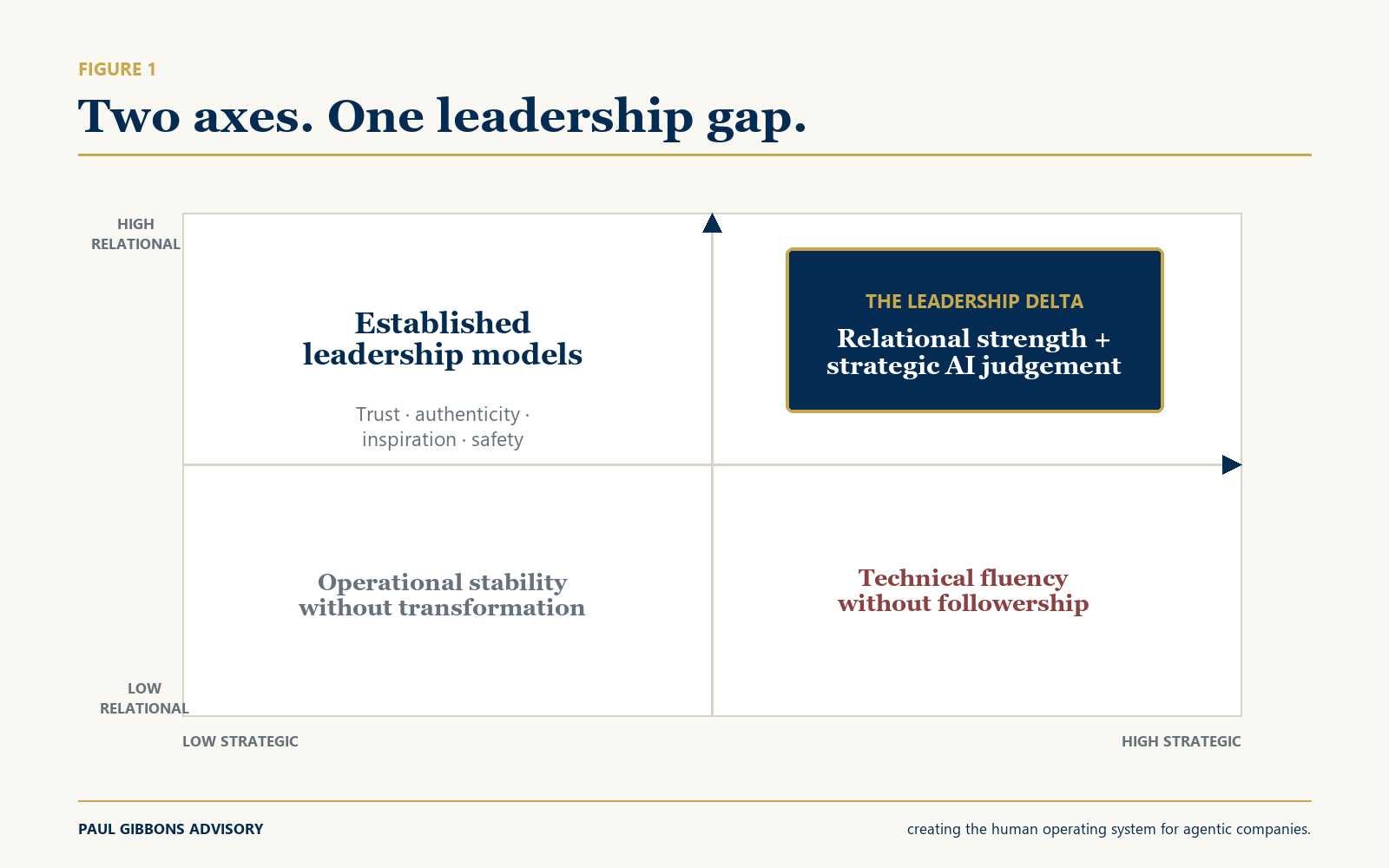
Figure 1. The Leadership Delta combines relational strength with strategic AI judgement.
Part III — Why the Delta Exists: Six Conditions
The AI Leadership Delta does not begin with leadership. It begins with context. If the conditions facing leaders are not genuinely different, a new leadership framework is unnecessary. If they are, then leadership models that do not address them are incomplete by design.
Six conditions support the case for a structural upgrade in leadership practice. Each describes an observable feature of the operating environment, has an intellectual lineage, and carries a specific leadership implication.
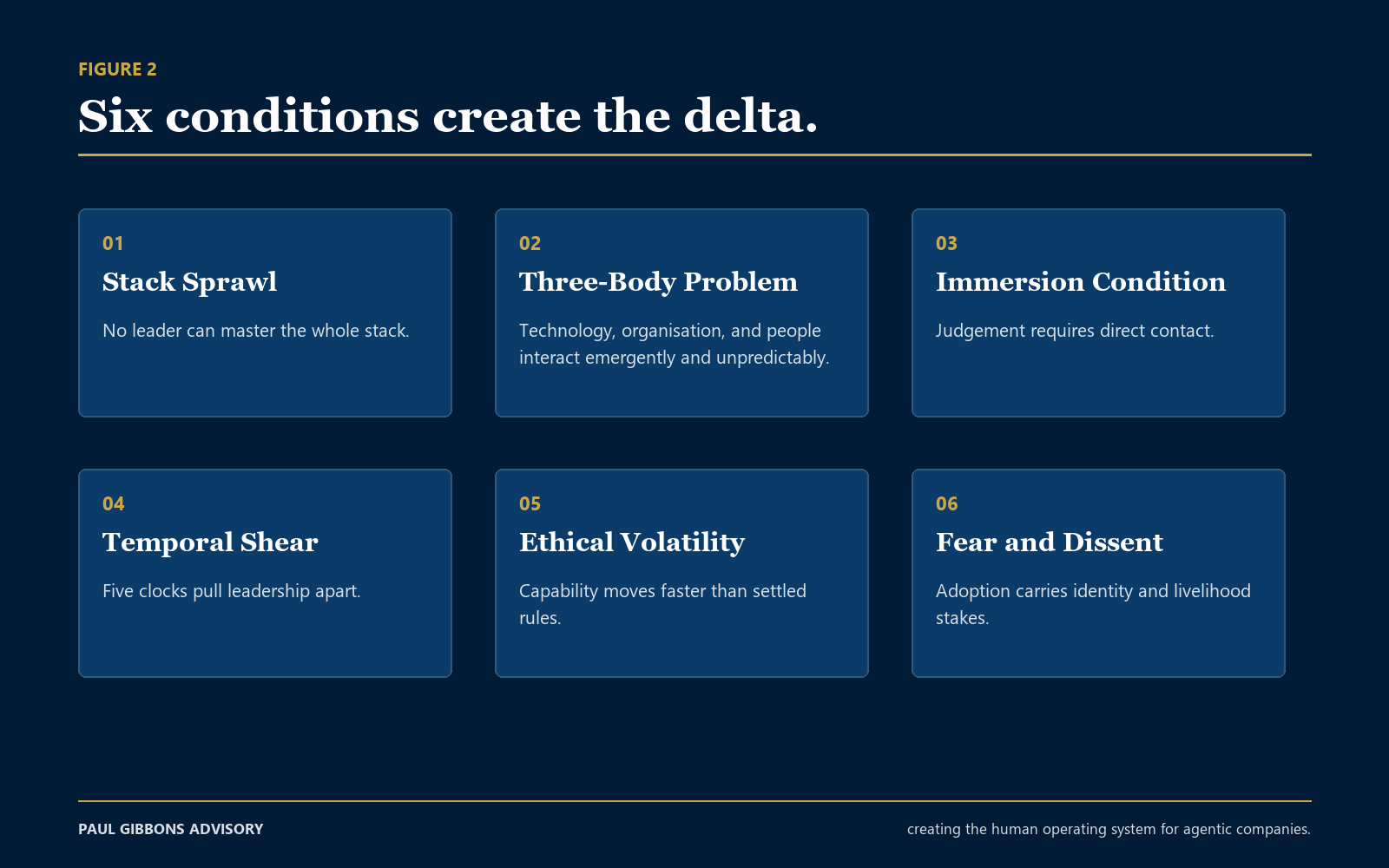
Figure 2. Six operating conditions make a structural upgrade in leadership practice necessary.
Condition 1: Stack Sprawl
The AI stack spans infrastructure (chips and data centres), foundation models, orchestration, applications, enterprise integration, and physical deployment. These layers expand simultaneously and operate through different technical and commercial logics. No executive can maintain deep mastery across the whole system.
Earlier enterprise technologies such as ERP, cloud, and mobile had more stable boundaries. AI joins infrastructure, model behaviour, data, workflow design, governance, and human use into one shifting system. Expertise in inference optimisation gives little insight into frontline adoption; skill in user experience says little about model evaluation or compute economics. The leadership problem is coordination across domains that do not share a language.
The implication is inverted expertise. The leader’s value lies in integrating distributed knowledge rather than knowing the most. This condition directly generates Dimension 7 (Systems Orchestration) and shapes the framework’s meta-architecture.
Intellectual lineage: Weick (sensemaking in complex organisations) · Snowden (Cynefin — complicated domain) · Gibbons (integral leadership and distributed expertise)
Condition 2: Complexity — The Three-Body Problem
The Stacey matrix distinction between complicated (expert-solvable, decomposable, predictable) and complex (emergent, non-linear, unpredictable) is well-established in organisational theory. What has not been adequately addressed is the nature of the complexity that AI introduces.
Most change models treat technology as a relatively passive system to be implemented and adopted. Contemporary AI can also generate, recommend, decide, and act with partial autonomy. Leaders must therefore manage three bodies in motion: humans with identities and careers, organisations with structures and politics, and probabilistic systems whose behaviour changes as models, tools, and contexts evolve. Technology, organisation, and people interact emergently and unpredictably.
This is the Three-Body Problem applied to organisational leadership. Interactions among the three bodies produce patterns that cannot be predicted by understanding any one in isolation. Linear plan-and-execute methods are therefore insufficient on their own; leaders need probe-sense-respond cycles, feedback, and reversible commitments.
Intellectual lineage: Clausewitz (fog, friction, and chance) · Kahneman (decision under uncertainty) · Taleb (antifragility, irreversibility) · Cynefin complex domain (Snowden) · Knight (risk vs. uncertainty)
Condition 3: The Immersion Condition
Valid strategic judgement about AI requires direct experience. The claim is epistemological: some knowledge of capability, failure, and workflow fit can be acquired only through contact with the technology.
Senior leaders do not need to become developers. They do need enough sustained contact to ground assessments of capability, risk, and opportunity in more than filtered briefings. Michael Polanyi’s “we know more than we can tell” runs in reverse here: leaders who have never worked directly with the technology know less than they think, because reports and demonstrations cannot transfer its tacit dimension.
The well-read analyst who has never built with the technology should hold strong conclusions lightly. Reading remains valuable, but contact reveals failure modes, affordances, and workflow consequences that abstraction hides. Bill Gates institutionalised Think Week as protected time for strategic reading. AI-era leaders also need Build Week: protected time for making, testing, and breaking.
This condition directly generates Dimension 2 (Active Modelling), shapes the learning architecture across the framework, and is the intellectual foundation for the BUILD-first programme design.
Intellectual lineage: Polanyi (tacit knowledge) · Dreyfus (skill acquisition stages) · Argyris & Schön (theory-in-use vs. espoused theory) · Bandura (social learning)
Condition 4: Temporal Shear
Five clocks run simultaneously at incompatible speeds: model releases on weekly cycles, agentic advances over months, budgeting and planning by quarter, legacy replacement over years, and human behaviour change over still longer periods. They cannot be fully synchronised.
The consequence is shear: organisational plates moving at different velocities. Quarterly strategy can age before delivery. Matching every model release would exhaust the organisation’s capacity for change. Respecting the human clock can look like paralysis when measured against the technology clock.
Temporal Shear goes beyond the familiar claim that change is accelerating. It describes the structural impossibility of keeping all relevant clocks coherent. The leadership response — holding a generational arc while navigating weekly shifts — generates Dimension 1 (Strategic Imagination) and the Prophet archetype.
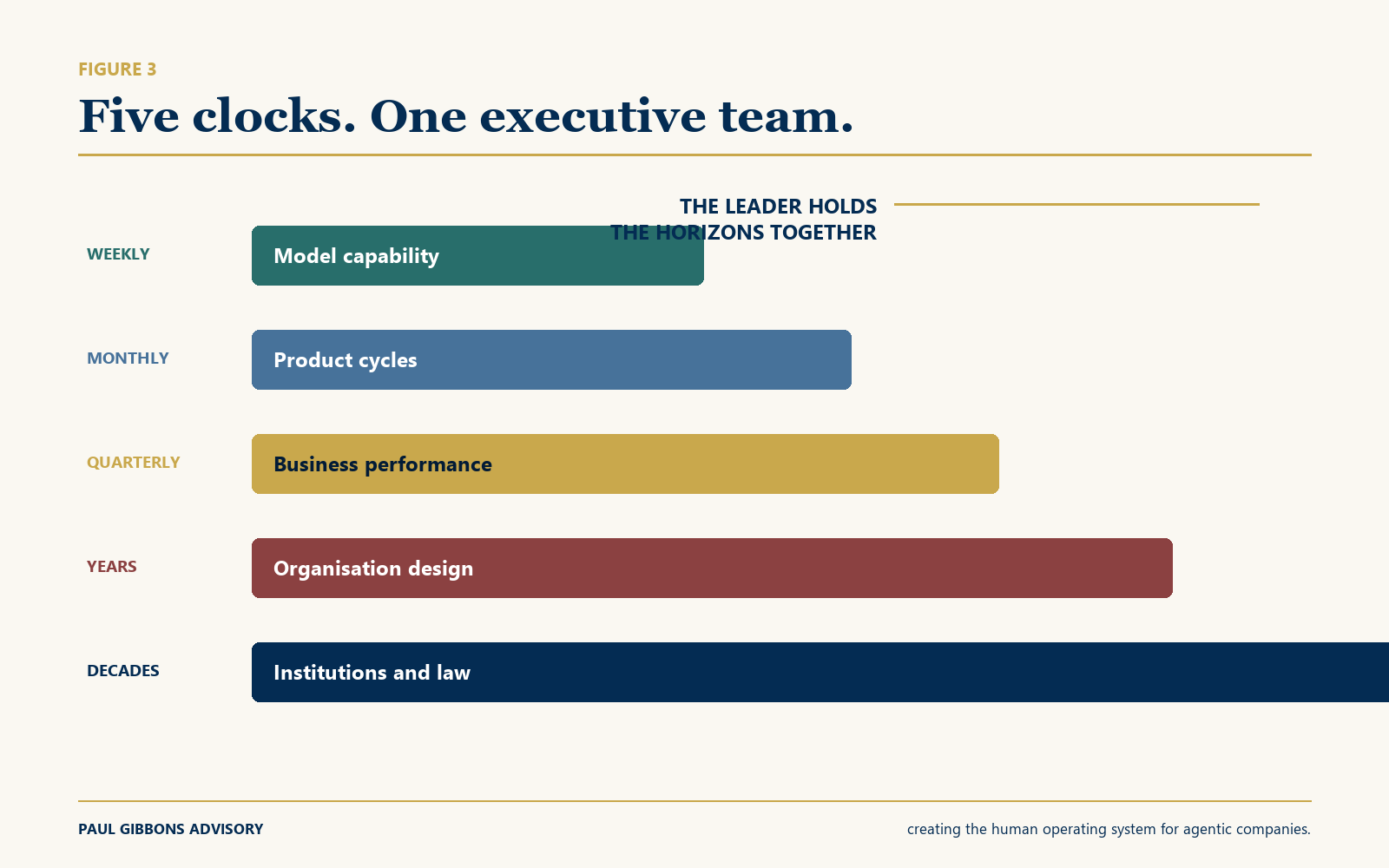
Figure 3. Leaders must hold several incompatible time horizons together.
Intellectual lineage: March (exploration-exploitation tension) extended into a domain where the exploration cycle has compressed to weeks while the exploitation cycle remains measured in years · Weick (sensemaking and time) · Heifetz (adaptive vs. technical challenges) · Tushman & O’Reilly (ambidextrous organisations)
Condition 5: Ethical Volatility
Novel moral questions can arise faster than formal governance adjudicates them. By the time a committee meets, a local deployment decision may already have been made. Rapidly changing capabilities continually create new ethical territory.
A compliance model based on writing and enforcing rules assumes a reasonably stable landscape. AI strains that assumption. Deepfakes, autonomous decisions in high-stakes domains, bias arising from training evidence, and surveillance embedded in productivity tools raise questions that many policy libraries were never written to answer.
The leader becomes the ethicist in the room by default. Philosophical training is optional; authority and organisational context are not. This condition generates Dimension 6 (Ethical Stewardship) and the Helmsman archetype.
Intellectual lineage: Burns (transforming leadership as moral exemplar) · Gibbons (purposeful leadership and ethical leadership) · Argyris (theory-in-use) · Aristotle (phronesis — practical wisdom) · contemporary AI law and governance
Condition 6: Fear and Dissent
AI has produced organised intellectual and ethical dissent across academia, civil society, technology, and the workforce. This goes beyond familiar resistance to a new enterprise system. Some objections concern jobs; others concern power, surveillance, autonomy, environmental cost, epistemic integrity, or catastrophic risk. They are positions, not communication failures.
Scepticism and dissent require different responses. Scepticism doubts capability claims and can be addressed with evidence, demonstration, and direct experience. Dissent rejects the direction of travel on principled grounds and cannot be dissolved with evidence alone. Treating it as a communication problem misdiagnoses the challenge. Leaders must acknowledge uncertainty, genuine risk, and legitimate counterarguments.
Fear also operates at the level of identity. For many practitioners, expertise is both skill and self-conception. AI may reduce the value of some forms of expertise faster than organisations can redesign roles or support adaptation. The fear is rational, and many organisational responses remain inadequate.
The simultaneous presence of undertrust (fear, refusal, identity threat) and overtrust (automation bias, output laundering, uncritical adoption) is the distinctive trust challenge of this condition. Both failure modes operate in the same organisation at the same time, requiring different interventions. This condition generates Dimension 5 (Trust Calibration) and shapes Dimension 3 (Creative Cultivation) and Dimension 4 (Friction Courage).
Intellectual lineage: Edmondson (psychological safety) · Argyris (defensive routines) · Festinger (cognitive dissonance) · Pew Research, Edelman Trust Barometer, EU Eurobarometer (current social research on AI attitudes)
The Internal Tumult Insight
The six conditions describe external pressure. AI also acts as an organisational mirror, exposing dysfunction that was previously tolerable: broken hand-offs, ceremonial governance, weak decision rights, and leaders unwilling to confront accumulated friction. Faster adoption cycles make those weaknesses visible and urgent.
The AI Leadership Delta therefore responds to both external conditions and internal exposure: what has changed around the organisation, and what the technology reveals within it.
Part IV — The Meta-Architecture: I-We-It
The seven dimensions required an organising structure. Two options were considered and rejected before the architecture was settled.
The first attempt used the Change Agility pillars in Adaptive Adoption: tools, skills, processes, and behaviours. That structure failed because the unit of analysis differs. Change Agility asks what the organisation needs; the Leadership Delta asks what the leader must do differently. Tools and processes are organisational constructs, not a sufficient map of leadership behaviour.
A simple list communicated well but failed operationally because it could not distinguish personal habits, interpersonal behaviour, and system-level design choices.
The architecture that works is my adaptation of Ken Wilber’s Integral Theory to leadership theory, simplifying four quadrants to three domains. Wilber’s four-quadrant model was the founding intellectual architecture of Future Considerations in 2001:
Lead Self (I) — the leader’s own habits, practices, and internal disciplines. What you do when no one is watching. The daily and weekly practices that build the capability over time.
Lead Others (We) — the leader’s observable behaviours with and toward other people. What you do in the room. How you show up, what you model, what you reward and punish through your visible actions.
Lead System (It) — the architectural conditions the leader creates or destroys. What you build. The structures, incentives, governance, and infrastructure that outlast any individual conversation.
This three-domain structure applies to all seven dimensions, creating a 7×3 matrix of 21 operational cells — each containing one or two specific, assessable behavioural practices. The I-We-It architecture ensures that each dimension is simultaneously personal (the leader must change their own behaviour), interpersonal (the leader must change how they interact), and structural (the leader must change what the organisation enables).
The intellectual lineage runs from Wilber through Aristotle’s tripartite schema (ethos, pathos, logos) and resonates with virtually every serious leadership tradition that distinguishes between character, relationship, and system.
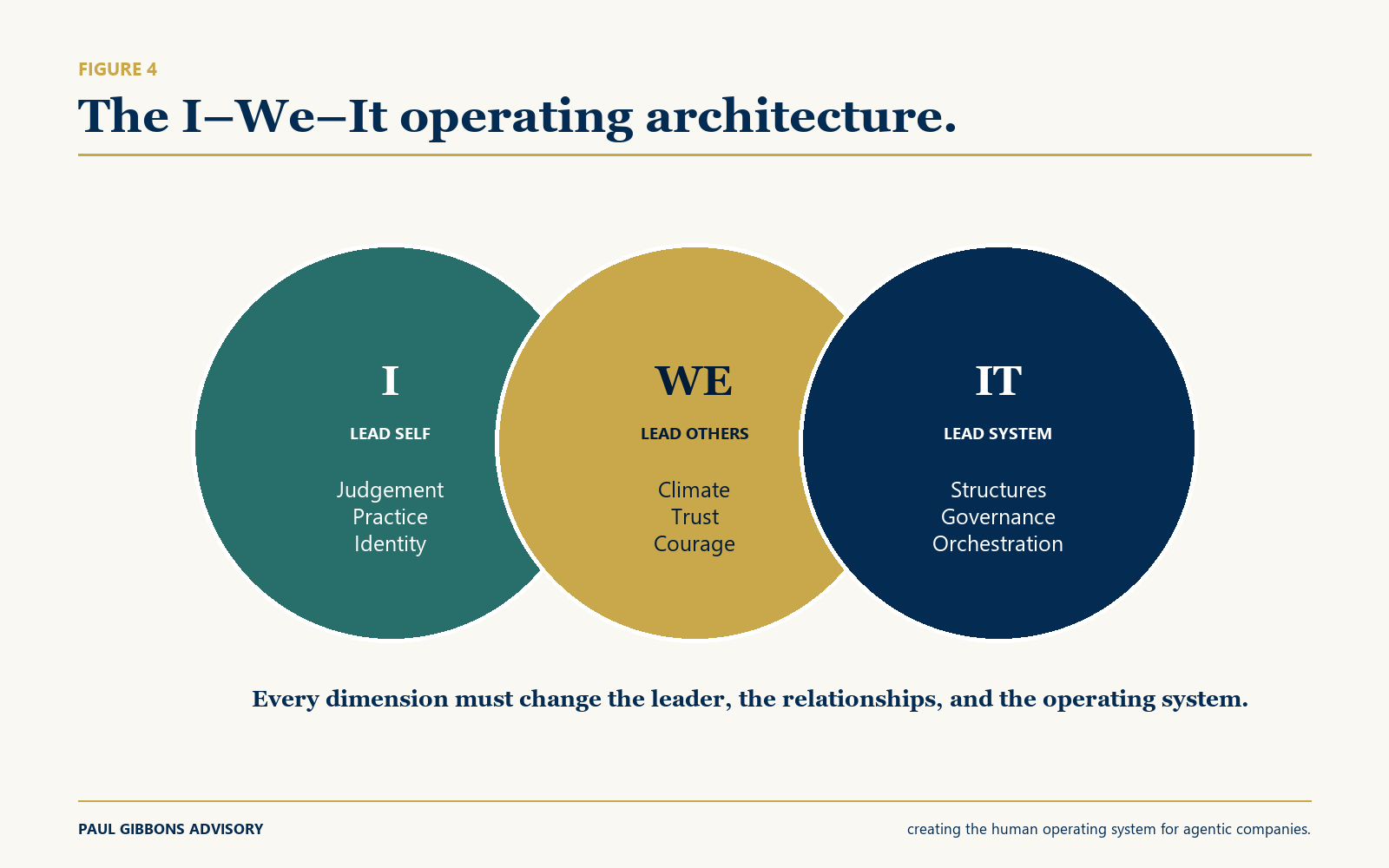
Figure 4. Every dimension is expressed through the leader, relationships, and the operating system.
Part V — The Seven Dimensions
What the Dimensions Are — and Are Not
The dimensions are framed as practices rather than static competencies. Each describes something a leader does: observable behaviour that can be tested over thirty days. The distinction matters for assessment and development.
The dimensions are not derived algorithmically from the conditions. The conditions explain the context; the dimensions specify the response. Their relationship is many-to-many and logical rather than mechanical.
Each dimension has an archetype — a role metaphor that makes the behavioural pattern memorable and transferable. The archetypes are pedagogical vehicles, not personality types.
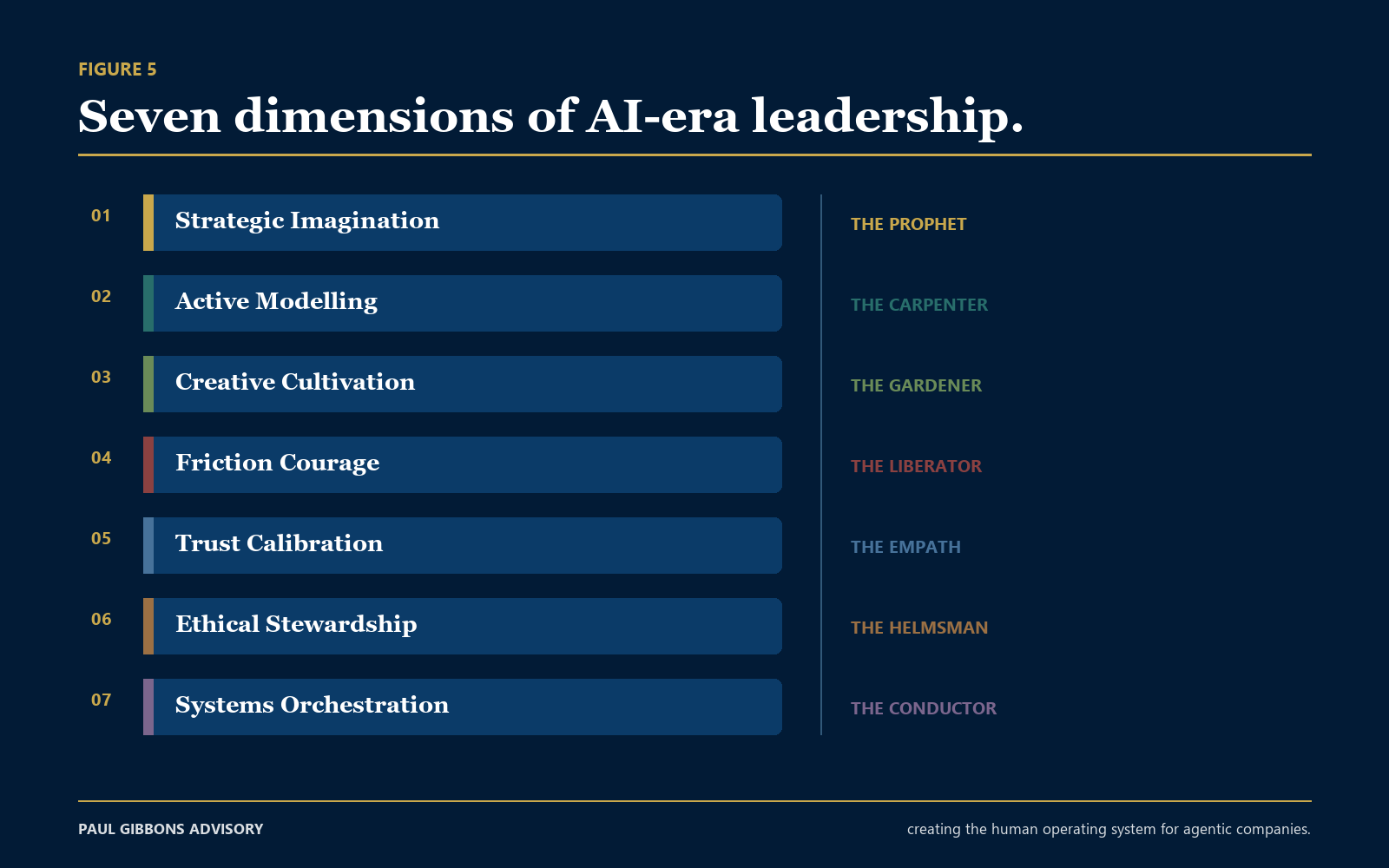
Figure 5. Seven practices translate the operating conditions into observable leadership behaviour.
Dimension 1: Strategic Imagination
THE PROPHET ← Temporal Shear · The Immersion Condition
“When they talk about the next quarter, they mean the next quarter century.” Offence, not defence. Building, not renting.
This is the dimension least well represented in established leadership models. Its components have precedents in strategy, innovation, and technology leadership, but their combination here is specific to the AI operating environment.
The core claim concerns strategy rather than vision. Renting AI capability through SaaS subscriptions can be sensible, but exclusive dependence on vendors limits organisational learning and proprietary advantage. RIM, Kodak, and DEC did not fail because their leaders lacked intelligence. Defending the existing position felt rational quarter by quarter until the accumulated strategic cost became overwhelming. The posture that matters is offence versus defence: deciding where to build, where to rent, and where imagination matters more than optimisation.
Lead Self: Frontier Time — protected, structured cognitive space where the question is not “what should we do next quarter?” but “what does this technology make possible that we haven’t imagined?” This is not horizon scanning (reading with a fancy name) but genuine strategic imagination. The constraint is not vision — it is the quarterly clock that eliminates the space where imagination happens. The companion practice is Right Inputs Discipline: having the right inputs before the protected time. Frontier developments, not executive summaries. Direct contact with what is shipping, not filtered briefings.
Lead Others: Naming the Scared Money — calling out incrementalism for what it is: fear disguised as prudence. The leader’s behavioural job is saying the uncomfortable thing in the room. And Holding the Arc Under Quarterly Pressure — not abandoning the five-year direction because Q2 was soft. Every board meeting is a test: collapse into the accountability clock or hold the generational narrative.
Lead System: AI-Enabled AI Strategy — the recursive loop. Build AI systems that augment the organisation’s capacity to think strategically about AI. Research agents, automated competitive intelligence, AI-assisted scenario planning. The technology itself as the enabler of its own strategic adoption. And Frontier Time for Everyone — structurally guaranteeing that protected strategic thinking time is not a C-suite luxury. If only the top floor thinks expansively, the organisation’s strategic intelligence is a bottleneck, not a capability.
Dimension 2: Active Modelling
THE CARPENTER ← The Immersion Condition · Complexity
“An AI sponsor who doesn’t use AI is a contradiction — not a sponsor.”
The Immersion Condition (Condition 3) generates this dimension directly. A leader’s public AI use gives symbolic permission in the Bandura social learning tradition and also serves an epistemic purpose: strategic judgment becomes grounded in contact knowledge rather than armchair inference. This dimension connects most directly to the programme’s BUILD-first design. You cannot model what you have not built.
Lead Self: Build Week — structured immersion where the leader builds with AI tools, not reads about them. Bill Gates had Think Week. AI-era leaders need Build Week. The companion practice is Tinker Time — regular, hands-on making embedded in real work. Not demos, not showcases. Genuine building. The leader who has not built with the technology has not earned their strong opinions about it.
Lead Others: Public Learning — visible, honest AI use including public acknowledgment of failure. What leaders are seen doing is the policy that actually governs behaviour, regardless of what the policy document says. Chris Argyris called this theory-in-use versus espoused theory. And Earned Opinion Standard — explicitly naming the standard that strong opinions about AI require direct experience.
Lead System: Immersion Infrastructure — organisation-wide access to frontier tools, dedicated experimentation time (not “innovation Friday” theatre), sandbox environments. And Competence Visibility Systems — mechanisms that make AI adoption visible without surveillance: team showcases, workflow-sharing platforms, rituals that make modelling contagious, not mandated.
Dimension 3: Creative Cultivation
THE GARDENER ← Fear and Dissent
Climate influences who captures AI productivity gains. It is a distributional choice as well as a cultural one.
Leaders create climate. It is not an HR programme or a culture initiative. It is the direct output of how leaders behave in rooms over time. Göran Ekvall’s research on organisational climate for creativity and innovation identifies ten dimensions: Challenge, Freedom, Trust/Openness, Idea Time, Playfulness, Conflict (low), Debate (high), Risk-taking, Dynamism, and Support for Ideas. This predates Amy Edmondson’s psychological safety by five years and is operationally richer.
The distributional claim sharpens the urgency. Dell’Acqua and colleagues found that consultants below the pre-experiment performance average gained more from AI than those above it on tasks within the model’s capability frontier. On a task outside that frontier, participants using AI were less likely to reach the correct answer. The practical lesson is that access alone does not determine value: experimentation, task selection, verification, and the surrounding climate shape who benefits and where AI becomes a liability.
Lead Self: Creativity and Innovation Behaviour Self-Audit — regular self-assessment against the ten climate dimensions. The honest question: which of these am I suppressing through my own behaviour this week? And Curiosity Before Judgment — the practised habit of asking “tell me more” before evaluating. One dismissive response from a leader kills ten experiments.
Lead Others: Celebrating Intelligent Failure — publicly rewarding well-designed experiments that failed, alongside successes. Climate is created by what gets celebrated, rather than what gets declared. And Dissent as Signal, Not Threat — treating organised resistance to AI as information rather than insubordination. The dissent is genuine and often principled. Engage it or lose the signal.
Lead System: Safe-to-DO Infrastructure — psychological safety to speak must be matched by structural safety to act. Budget lines for experiments with no required ROI projection. Governance cadence that matches experimentation speed. KPIs that measure learning rate alongside success rate. Safe to say is table stakes. Safe to do is the real climate. And Diversity of Thought as System Design — neurodivergence as an asset rather than an accommodation. The team that thinks the same way will adopt AI the same way and miss everything the pattern does not contain.
Dimension 4: Friction Courage
THE LIBERATOR ← Fear and Dissent · Complexity
The failure mode isn’t stupidity — it’s cowardice. They know the silos are broken. They don’t act.
This was the hardest dimension to name because it requires two opposite aggressive actions simultaneously. The leader must break things — tell legal to take a hike, gut the silo, remove the governance review that takes longer than the initiative it reviews — with Welch-level willingness to destroy unproductive structures. And the leader must protect things — recognise that this wall is load-bearing, shore up the ethical review process, say no to the CEO who wants to ship fast when speed will cause harm. Both moves require courage. Neither is passive.
A recurrent large-organisation failure mode is cowardice disguised as governance. Leaders often know where the broken frictions are but lack the courage to act on either side.
Lead Self: Purge Self-Frictions — pro-level self and time management as leadership prerequisite, and this means ruthless, not incremental. The executive who cannot manage their own calendar, who says yes to everything, whose inbox runs them — that person cannot credibly liberate an organisation from structural friction. You cannot tell legal to take a hike if you cannot tell your own meeting schedule to take a hike. And Courage Inventory — a monthly honest audit: what friction do I know is broken that I have not acted on? The inventory separates strategic patience from cowardice.
Lead Others: Break the Structures, Love the People — the paradox at the heart of this dimension. The leader who breaks structures and breaks people is a sociopath. The leader who loves people but will not break structures is a coward. Both are common. Neither works. Gut the silo, protect the person. Tell legal to take a hike, take the lawyer to lunch. And Naming the Cowardice — calling out organisational cowardice, including your own, as a leadership act.
Lead System: The Dual Mandate — Protect AND Expand. The protect/break ratio is not fixed. It is calibrated to ambition. Low growth ambition: you can protect heavily, optimise incrementally, keep the frictions. High growth ambition: you have to break things, accept some casualties, move fast through discomfort. The organisational sin is having high ambition and a protect-heavy posture — wanting transformation outcomes with optimisation behaviours. And Friction Audit Protocol — systematic mapping of deliberate versus accidental frictions. Deliberate frictions (ethical review, security checks) are load-bearing. Accidental frictions (legacy approval chains, silo-driven handoffs, compliance theatre) are structural debt. If removing a blocker requires a committee, the committee is the blocker.
Dimension 5: Trust Calibration
THE EMPATH ← Fear and Dissent · Simultaneous Under/Overtrust
Trust is not a feeling to manage — it is a four-dimensional dynamic to calibrate. Continuously. The RIST Framework™: Relational, Institutional, Self-Trust, Task Trust.
Trust is often treated as a byproduct of good leadership: the presumed result of transparent communication, visible sponsorship, and consistent behaviour. The Leadership Delta makes it a named dimension to be diagnosed and managed in its own right.
The RIST Framework™ (Gibbons) identifies four trust dimensions, each with distinct failure modes: Relational Trust (Human→Livelihood) fails when leaders treat trust as a communication problem rather than a behavioural one; Institutional Trust (Tech→Governance) fails when governance structures lag capability by months or years; Self-Trust (Self→Relevance) fails when professionals calcify a 2022 assessment of AI into permanent identity; and Task Trust (Model→Task) fails when consequence-based tiering is replaced by anxiety-based blanket policies.
Each dimension has two failure modes — undertrust and overtrust — and the interventions are entirely different. This is the distinctive challenge: both failure modes operate simultaneously in the same organisation.
Lead Self: Self-Trust Audit — the S in RIST. The question is not “Am I competent with AI?” but “Am I confident in my ability to learn AI?” Self-trust failures are identity failures. First-derivative talent: your rate of learning matters more than your current knowledge. And Know Your Trust Defaults — every person arrives at every trust decision carrying priors. Our evolved trust machinery runs on theory of mind, but you cannot have an accurate theory of mind about an AI. What AI does instead — through language tuned for helpfulness and warmth — is trigger trust responses uncalibrated to actual capability. Someone whose default is scepticism will undertrust AI despite strong performance. Someone whose default is deference will overtrust it despite significant limitations. Neither response is calibrated. Both feel like judgment.
Lead Others: Diagnose Before Prescribing — the RIST diagnostic. Most trust interventions fail because organisations treat the symptom (low adoption) rather than the specific trust dimension that has failed. A Self-Trust failure requires learning architecture. A Relational Trust failure requires behavioural leadership. A Task Trust failure requires verification protocols. An Institutional Trust failure requires governance reform. Applying the wrong intervention wastes time and signals incompetence, which makes trust worse. And Trust Is Behavioural, Not Communicative — every tool in the RIST toolkit is behavioural. Words without deeds destroy trust faster than silence. The leader who announces “we’re building a culture of trust” while running nine-month legal review cycles for AI tools is not building trust but performing it.
Lead System: Consequence-Based Trust Tiering — the T in RIST. Task trust calibrated by consequence, not by anxiety. Low stakes (drafting, brainstorming): use freely, spot-check occasionally, preserve speed. Medium stakes (customer-facing, quantitative claims): verify sources, human review before use. High stakes (legal, medical, financial, reputational): expert review required, evidence trail documented, never use unreviewed. Undertrust is the expensive failure — productivity foregone. Overtrust is the dangerous failure — output laundering, where AI generates and a human signs off without meaningful review. And Assume Fallibility, Not Bad Intent — zero trust applied to technology has merit. Zero trust applied to people is Theory X dressed in cybersecurity language. Permission gates slow adoption and suppress the experimentation that makes it valuable. The deeper cost is talent: people who feel unblocked build; people who feel untrusted comply — minimally, defensively, without the curiosity that makes AI adoption work.
Dimension 6: Ethical Stewardship
THE HELMSMAN ← Ethical Volatility · Ethical Fading
Ethics isn’t compliance and it isn’t moralising — it’s phronesis: the practical wisdom to navigate novel moral terrain where the rules don’t exist yet.
Aristotle distinguished three forms of knowledge: episteme (theoretical knowledge — the compass, the map), techne (craft skill — moving over rough terrain), and phronesis (practical wisdom — the judgment that governs both). The leader with episteme and techne but no phronesis knows the compliance rules and can operate the technology but lacks the judgment to ask: just because we can, should we?
The sailing metaphor captures what orienteering cannot. The helmsman reads conditions that are actively changing. The wind shifts. The ethical landscape shifts weekly — new capabilities, new harms, new edge cases. The helmsman who knows the rules of sailing and has technical skill at the helm but cannot read the weather, cannot feel when to reef, cannot judge whether to press on or turn back — that is phronesis missing. And the helmsman sails with a crew: the ethical leader is not navigating alone but reading the crew’s fatigue, managing the risk appetite of people who depend on their judgment.
Lead Self: Phronesis — the Helmsman’s Judgment. The meta-ethical skill: knowing when this is a utility question (what outcome do we want?), when it is a rights question (what lines cannot be crossed?), and when it is a character question (who are we becoming?). Phronesis selects the right ethical lens for the context. And Ethical Fading Awareness — the discipline of noticing when moral questions get reclassified as “just business decisions.” Ethical fading is not cynicism. It is the gradual, invisible process by which the ethical dimension of a decision disappears from view. The ROI model that strips out the displacement impact. The efficiency metric that obscures the surveillance. The “alignment” initiative that is actually coercion with a friendly name.
Lead Others: Ethical Judgment Without Moralising — the word “ethics” has almost no currency at board level. It triggers images of philosophy departments and HR compliance modules. The actual skill is rarer and harder: offering clear moral judgments — this is right, this is wrong, this creates harm — without rancour, without condescension, in the language of the room. “Risk,” “values,” “liability,” “reputation” — these land where “ethics” bounces. The leader who can translate ethical reasoning into strategic language without losing the moral weight is doing something most executives cannot do at all. And Red Line Visibility — publicly naming what you will not do, and accepting the cost. The leader who says “we won’t ship this even though it’s profitable” has done more for ethical culture than a hundred policy documents.
Lead System: Anti-Fading Architecture — ethical fading is not individual weakness. It is what systems produce when no one designs against it. Decision templates that force the ethical dimension to remain visible. Pre-mortems that include “who could this harm?” as a required field. Deployment checklists that require the ethical question to be answered rather than merely acknowledged. And Ethical Stop Cord — frontline veto power on AI deployment. Anyone can pull the cord, and pulling it is celebrated, not punished. The stop cord works because it assumes the people closest to the work see things the hierarchy cannot.
Dimension 7: Systems Orchestration
THE CONDUCTOR ← Stack Sprawl
The conductor produces coherent music from incommensurable instruments without playing any of them. Inverted expertise.
Stack Sprawl (Condition 1) demands a leadership response that general leadership models rarely make explicit. If the stack spans chips to agents and no single person can hold the whole system, what does effective leadership look like?
The answer is orchestration rather than mastery. The orchestra conductor produces coherent music from instruments that operate on different principles without playing each one. The conductor’s value is making distributed expertise legible and actionable across boundaries that do not share a common language. This is inverted expertise: seniority no longer guarantees the deepest relevant knowledge. Stack Sprawl makes command based on presumed mastery unreliable and, at times, harmful.
Lead Self: Epistemic Humility Practice — cultivating comfort with knowing less than the people you lead, permanently, not temporarily. Every prior leadership model assumes the leader has or can acquire superior knowledge. Stack Sprawl makes this impossible. The practice is learning to lead from a position of curated ignorance. And Cross-Domain Literacy Habit — regular shallow-but-wide engagement across incommensurable domains: infrastructure, models, orchestration, applications, enterprise, physical. Not mastery. Pattern recognition. The conductor reads every score, plays no instrument.
Lead Others: Translation Between Ontologies — active mediation between teams that literally speak different languages: data engineers, UX designers, legal, ethics, frontline users. The leader’s value is making distributed knowledge legible across boundaries — asking the right questions of people who know more than you in their domain. And Knowing When to Override Versus Defer — the judgment call that defines orchestration. The conductor who always defers produces cacophony. The conductor who always overrides suppresses the distributed expertise that is the only adequate response to the stack’s complexity.
Lead System: Integration Architecture — organisational design that makes cross-domain collaboration structural, not heroic. Shared ontologies, translation layers between teams, governance that connects rather than silos. If integration depends on one leader’s relationship capital, it is fragile. And Distributed Expertise Model — reward systems, team structures, and decision rights designed for inverted expertise. Build the team as the instrument. The system’s intelligence is the orchestra, not the conductor.
Part VI — The Programme: Built, Not Lectured
The Leadership Delta has a double meaning. It is the gap between current leadership capability and what the AI moment requires. It is also the programme that closes that gap.
The programme design follows directly from the framework. Strategic judgment about AI requires direct experience, so a lecture series is insufficient. Active Modelling requires leaders to build visibly before asking others to do so, which places building at the start. Because the central gap is behavioural as well as informational, the programme must change what leaders do in their work.
These are not pedagogical preferences. They are structural requirements of the framework itself.
Build-First
The programme changes the orthodox sequence. Theory, cases, and strategic frameworks remain essential, but they alternate with direct construction rather than preceding it by weeks or months. Leaders encounter an idea, build against it in their real work, test its limits, and return to the theory with better questions and more grounded judgment.
The carpenter learns by making. The leader learns by building. Constructing working AI systems is both useful work and a foundational strategic experience.
Briefings create awareness. Building creates contact knowledge.
Bill Gates popularised Think Week: protected time for reading and strategic reflection. The Leadership Delta combines protected time for thinking with protected time for making. Strategic reading produces propositional knowledge, while strategic building develops tacit knowledge. Michael Polanyi’s insight that “we know more than we can tell” matters here: some understanding of AI capability cannot be transferred through information alone.
The Programme Architecture
The flagship is structured as nine half-day studios, each approximately three to four hours. Across three movements — Understand and Build, Decide and Lead, Govern and Orchestrate — participants move between serious theory, frontier briefings, case discussion, peer inquiry, and construction in their real work. Substantial build intensives anchor the arc, while applied work runs through every session.
This is twenty-seven to thirty-six hours of executive education for leaders responsible for AI value, people, and governance. The programme spans technology, strategy, decision quality, leadership, behavioural science, organisational change, ethics, and systems orchestration without treating any of them as sufficient alone. Its practical opening targets a five-to-ten-hour weekly capacity dividend, deliberately reinvested in AI learning, strategic thought, and human connection.
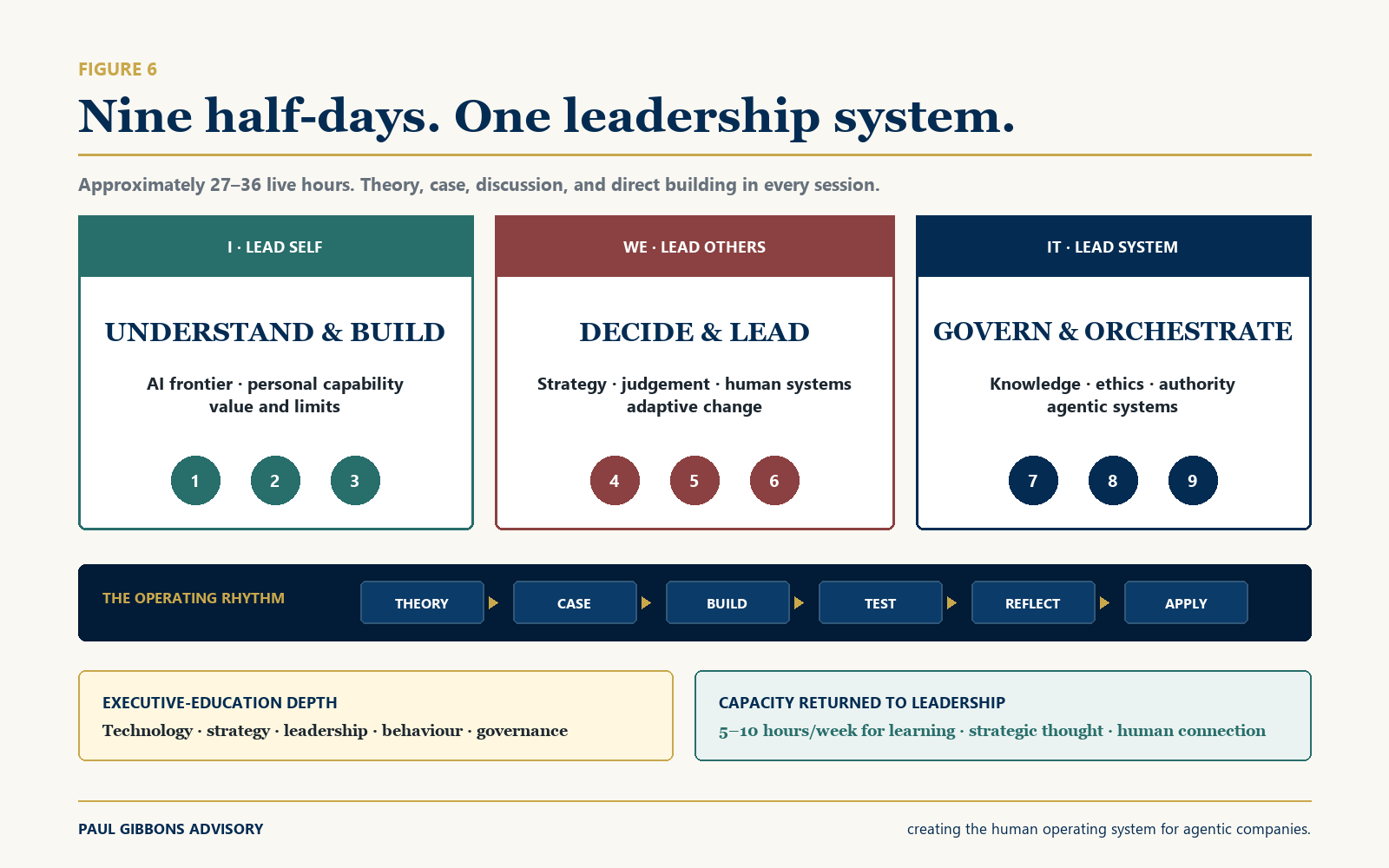
Figure 6. Nine theory-rich, build-intensive half-days move from personal contact with AI to organisational leadership and governed orchestration.
Why Build-First Works: The Intellectual Case
The case rests on four converging lines of evidence:
Tacit knowledge. Polanyi’s insight that “we know more than we can tell” applies with particular force to AI capability assessment. The practitioner who has built, broken, and rebuilt with AI tools carries strategic intelligence that cannot be acquired through briefings, courses, or analyst reports. The Immersion Condition (Condition 3) is the framework’s formalisation of this claim.
Skill acquisition. The Dreyfus model demonstrates that expertise progresses from novice through competent to expert only through practised engagement with real cases, not through instruction. A leader at the novice stage of AI — regardless of seniority, domain expertise, or intellectual capability — cannot shortcut to expert judgment through information alone. The programme accelerates the Dreyfus progression by providing structured building experiences at escalating complexity.
Theory-in-use. Argyris’s distinction between espoused theory and theory-in-use describes the gap between stated policy and enacted behaviour. Enterprise AI strategies often live in policy documents and strategy decks while daily work remains unchanged. Build-first narrows that gap because learning and application occur in the same work context.
Transfer conditions. Baldwin and Ford’s research shows that application depends on training design, the work environment, opportunity to perform, and reinforcement. Alan Saks later showed that the often-repeated claim that only 10 per cent of training transfers was never a robust empirical estimate. Build-first reduces the distance between learning and application by making real work the learning context; it does not guarantee transfer.
Three Delivery Formats
The Flagship Programme. Cohort-based, fifteen to twenty-five senior leaders, delivered through nine half-day studios of approximately three to four hours each. The programme combines executive-education depth with direct building and spans all seven dimensions, with pre/post diagnostic measurement. The cohort format is designed to create a visible group of AI-fluent leaders who can influence organisational climate together.
The AI Build Day. A separate one-day, in-person intensive focused on building an AI Chief of Staff. Participants arrive with their own work; they leave with a working system and a diagnostic gap report. It is designed as an entry point for executive teams and a practical extension of keynote engagements.
One-to-One Coaching. Applied Leadership Delta frameworks to a specific executive’s organisational context. For leaders whose organisations face acute AI adoption challenges and who need advisory that is diagnostic, behavioural, and tied to their specific strategic situation.
Part VII — Intellectual Provenance
The AI Leadership Delta is the product of three decades of practice, reflection, and later research. It draws first on my work in integral leadership, purposeful and ethical leadership, organisational culture and innovation, behavioural change, trust, and change agility. It also draws on traditions that range from Aristotle to behavioural science, from game theory to complexity science, from moral philosophy to the biographical study of leadership in practice.
This is therefore neither a fresh synthesis of other people’s models nor a claim of invention without ancestry. I presented early work on integral approaches to leadership at the Academy of Management in 1998 and published it in 2000. Wilber’s four-quadrant model became the founding architecture of Future Considerations in 2001. By 2004, the firm was operating with self-management, wholeness, and evolutionary-purpose practices that would later be described as teal. I began implementing Holacracy within Future Considerations in 2010. After I stepped away in 2012, the firm advised Zappos as it adopted Holacracy in 2013.
By 2005, Future Considerations had assembled an unusually integrated leadership and organisation-development practice. The repertoire was much wider than integral theory. It included my Five Levels of Accountability; somatic and embodied leadership drawing on Richard Strozzi-Heckler; ontological leadership studied with Julio Olalla in the Fernando Flores tradition; Spiral Dynamics; Adam Kahane’s Change Lab and scenario-planning methods; Barry Oshry’s systems thinking; Theory U; and intercultural leadership. Leadership and Self-Deception was a course text, and we taught an adapted version of Susan Scott’s Fierce Conversations.
Most of this integration lived in client work and leadership programmes rather than published theory. Until around 2010, I was almost entirely a practitioner. When the firm I had built broke apart and I stepped away in 2012, I also left the leadership-development world. I did not begin writing systematically until The Science of Successful Organizational Change was published in 2015, and that book was light on leadership. The AI Leadership Delta recovers those earlier streams and brings them together under a new set of operating conditions.
Aristotle’s distinction between episteme, techne, and phronesis provides the backbone of Dimension 6. Practical wisdom governs the application of knowledge and skill, which is why AI ethics cannot be reduced to compliance.
Ken Wilber’s Integral Theory is the source architecture. I adapted it to leadership as I-We-It: Lead Self, Lead Others, and Lead System. Every dimension in the Delta is structured through this operational lens.
Ronald Heifetz’s distinction between technical and adaptive challenges runs through the framework. A central failure in AI adoption is treating an adaptive problem as a technical implementation.
Work by Nassim Taleb, Benoît Mandelbrot, Nate Silver, and Andrew Lo informs the framework’s treatment of uncertainty, probabilistic judgment, and calibration.
Onora O’Neill’s Reith Lectures inform RIST’s central idea: trust should be intelligently placed in the trustworthy.
James MacGregor Burns supplies the transformational claim that incremental optimisation is insufficient. John F. Kennedy’s Profiles in Courage informs Dimension 4: knowing what to do is different from having the courage to do it.
Chris Argyris’s single-loop and double-loop learning informs Dimension 2: leaders who learn about AI without learning from AI are single-looping.
Hardin’s tragedy of the commons frames unmanaged AI governance. Donella Meadows supplies the systems grammar of leverage points and feedback loops. Elinor Ostrom provides the alternative to centralised control: polycentric governance with nested rules and distributed authority.
Part VIII — Where This Was Built
The AI Leadership Delta was built across three decades of advisory, teaching, writing, and direct work with emerging technology. Its starting point is practical: what changes leadership behaviour under pressure, and what survives contact with the organisation.
Paul Gibbons designed his first senior leadership development programme in 1997. He later founded Future Considerations, advising global organisations on leadership and organisational change, and became an adjunct professor of business ethics and leadership. His books include The Science of Successful Organizational Change and Impact, which brought behavioural science, complexity, trust, digital transformation, and the future of work into the change debate.
He joined IBM Consulting as a partner in 2020, working across organisational leadership, culture, and change. In 2025, he launched Paul Gibbons Advisory and Adaptive Adoption™. The AI Leadership Delta brings that body of work into the operating conditions created by AI, informed by daily use of the systems and methods described here.
Conclusion: The Delta Is the Claim
Leadership studies have given us a deep account of the relational axis: trust, authenticity, inspiration, and psychological safety. That body of work remains essential. AI makes empathy more urgent, while exposing the limits of empathy without strategic and technological judgment.
The strategic demands are concrete: build-or-rent choices, augmentation sequencing, governance under volatility, rapid technology evaluation, proprietary knowledge, and disciplined experimentation. Existing models contain pieces of this agenda, but they do not assemble it for the operating conditions AI now creates.
The six conditions explain those operating conditions. The seven dimensions translate them into observable practices across self, others, and system. They can be assessed, tested in real work, and strengthened through deliberate practice.
The programme begins with building because direct contact changes the quality of leadership judgment. Leaders construct a useful system for their own work, discover its capabilities and failure modes, and then approach strategy, trust, ethics, and organisational design with earned knowledge.
The delta is the gap between the leadership we have developed and the leadership this environment requires. Closing it starts with work.
Appendix: Paul Gibbons’ Leadership Reading List
The books that built this framework
| Author | Work | One Line |
|---|---|---|
| Argyris, Chris | Organizational Learning | Single-loop vs. double-loop learning. Leaders who learn about AI without learning from AI are single-looping. |
| Arbinger Institute | Leadership and Self-Deception | How self-betrayal and an inward mindset distort leadership and relationships. Used as a Future Considerations course text. |
| Aristotle | Nicomachean Ethics | Phronesis — practical wisdom as the meta-virtue. The episteme/techne/phronesis distinction is the backbone of D6. |
| Bazerman, Max & Tenbrunsel, Ann | Blind Spots | Ethical fading — the invisible process by which moral dimensions disappear from business decisions. |
| Burns, James MacGregor | Leadership (1978) | The original theorist of transformational leadership. The entire Delta is a transformational claim. |
| Christensen, Clayton | The Innovator’s Dilemma | Why incumbents fail. The disruption logic behind D4’s Dual Mandate — protect AND expand. |
| Clausewitz, Carl von | On War | Fog of war as analogue for the AI stack’s opacity. The offence/defence strategic posture. |
| Crawford, Matthew | Shop Class as Soulcraft | The dignity and epistemology of working with your hands. You learn by making, not by reading about making. |
| Dreyfus, Hubert | Skill Acquisition | Novice-to-expert progression. Expertise is embodied, not propositional. Informs the Immersion Condition. |
| Duke, Annie | Thinking in Bets | Decision quality vs. outcome quality. The confidence interval discipline as practised speech. |
| Edmondson, Amy | The Fearless Organization | Psychological safety is necessary but incomplete. D3 adds structural safety to act. |
| Ekvall, Göran | Creative Climate Research | Ten dimensions of organisational creative climate. The empirical foundation for D3 Creative Cultivation. |
| Gates, Bill | Source Code (biography) | Think Week — protected cognitive space for strategic reading. Direct ancestor of Frontier Time. |
| Hardin, Garrett | Tragedy of the Commons (1968) | The default outcome when AI governance is unmanaged — shared resources degraded by uncoordinated optimisation. |
| Heifetz, Ronald | Leadership Without Easy Answers | Technical vs. adaptive challenges. The most dangerous failure: treating adaptive problems with technical solutions. |
| Isaacson, Walter | The Innovators; biographies of Jobs, Einstein, da Vinci | Leadership understood through enacted life, not abstracted principles. |
| Kahneman, Daniel | Thinking, Fast and Slow | Dual-process theory. Trust defaults and automation bias in D5 are System 1 failures in a System 2 domain. |
| Kennedy, John F. | Profiles in Courage | Political courage as the willingness to sacrifice career for conviction. The failure mode is not ignorance but cowardice. |
| Lo, Andrew | Adaptive Markets | Rationality is context-dependent, not fixed. Markets — and organisations — adapt or die. |
| Mandelbrot, Benoît | The (Mis)Behavior of Markets | Fat tails, not bell curves. The fractal geometry of risk underpins the rejection of neat planning models. |
| Meadows, Donella | Thinking in Systems | Leverage points and feedback loops. Where you intervene matters more than how hard you push. |
| O’Neill, Onora | A Question of Trust (Reith Lectures) | Calibrated trust — not more trust, but more trust in the trustworthy. |
| Ostrom, Elinor | Governing the Commons | Polycentric governance — nested rules, distributed authority. The alternative to both control and tragedy. |
| Polanyi, Michael | The Tacit Dimension | We know more than we can tell. Strategic judgment requires direct experience, not reports. |
| Schön, Donald | The Reflective Practitioner | Reflection-in-action. How professionals actually think in practice, not in theory. |
| Silver, Nate | The Signal and the Noise | Probabilistic thinking and the signal/noise distinction. The calibration discipline behind D5. |
| Scott, Susan | Fierce Conversations | Direct, consequential conversations as a leadership practice. Future Considerations taught an adapted version. |
| Snowden, Dave | Cynefin Framework | Domain distinctions — simple, complicated, complex, chaotic. Matching the intervention to the domain. |
| Stacey, Ralph | Complexity and Management | The Three-Body Problem condition. Complicated is expert-solvable; complex is emergent and unpredictable. |
| Taleb, Nassim Nicholas | Antifragile; The Black Swan; Skin in the Game | Systems that gain from disorder. Skin in the game as the prerequisite for consequential judgment. |
| von Neumann, John | Theory of Games and Economic Behavior | He chose poker over chess as game theory’s foundation. Incomplete information is the real game. |
| Wilber, Ken | Integral Theory | The I-We-It framework. Four quadrants simplified to three domains: Lead Self, Lead Others, Lead System. |
| Williams, Bernard | Ethics and the Limits of Philosophy | Moral theory alone is insufficient for practical life. The philosophical case for phronesis over theory. |
References
- Argyris, C. & Schön, D. A. (1974). Theory in Practice: Increasing Professional Effectiveness. Jossey-Bass.
- Arbinger Institute (2000). Leadership and Self-Deception: Getting Out of the Box. Berrett-Koehler.
- Avolio, B. J. & Gardner, W. L. (2005). “Authentic Leadership Development: Getting to the Root of Positive Forms of Leadership.” The Leadership Quarterly, 16(3), 315–338.
- Baldwin, T. T. & Ford, J. K. (1988). “Transfer of Training: A Review and Directions for Future Research.” Personnel Psychology, 41(1), 63–105.
- Bass, B. M. (1985). Leadership and Performance Beyond Expectations. Free Press.
- Beauchene, V., Duranton, S., Kalra, N. & Martin, D. (2025). “AI at Work: Momentum Builds, but Gaps Remain.” Boston Consulting Group. https://www.bcg.com/publications/2025/ai-at-work-momentum-builds-but-gaps-remain
- Berthion, M. (2026). “Five Barriers CEOs Must Overcome for AI Impact.” Boston Consulting Group. https://www.bcg.com/publications/2026/five-barriers-ceos-must-overcome-for-ai-impact
- Burns, J. M. (1978). Leadership. Harper & Row.
- Dinh, J. E. et al. (2014). “Leadership Theory and Research in the New Millennium: Current Theoretical Trends and Changing Perspectives.” The Leadership Quarterly, 25(1), 36–62.
- Dreyfus, H. L. & Dreyfus, S. E. (1986). Mind Over Machine: The Power of Human Intuition and Expertise in the Era of the Computer. Free Press.
- Edmondson, A. (1999). “Psychological Safety and Learning Behavior in Work Teams.” Administrative Science Quarterly, 44(2), 350–383.
- Ekvall, G. (1996). “Organizational Climate for Creativity and Innovation.” European Journal of Work and Organizational Psychology, 5(1), 105–123.
- Fleishman, E. A. et al. (1991). “Taxonomic Efforts in the Description of Leader Behavior: A Synthesis and Functional Interpretation.” The Leadership Quarterly, 2(4), 245–287.
- Gartner (2025). “How to Narrow Your C-Suite’s AI Skills Gap.” Gartner. https://www.gartner.com/en/articles/how-to-narrow-your-c-suites-ai-skills-gap
- Gibbons, P. (2019). The Science of Successful Organizational Change (2nd ed.). Phronesis Media.
- Gibbons, P. (2019). Impact: 21st Century Change Management, Behavioral Science, Digital Transformation, and the Future of Work. Phronesis Media.
- Gibbons, P. (2025). Adopting AI. Phronesis Media.
- Gibbons, P. (2026). “Solve for Trust: The RIST Framework for AI Adoption.” Think Bigger Think Better (Substack).
- Greenleaf, R. K. (1970). The Servant as Leader. Robert K. Greenleaf Center.
- Heifetz, R. A. (1994). Leadership Without Easy Answers. Harvard University Press.
- McKinsey & Company (2025). “The State of AI: How Organizations Are Rewiring to Capture Value.” https://www.mckinsey.com/capabilities/quantumblack/our-insights/the-state-of-ai
- McKinsey & Company (2025). “Superagency in the Workplace: Empowering People to Unlock AI’s Full Potential at Work.” https://www.mckinsey.com/capabilities/tech-and-ai/our-insights/superagency-in-the-workplace-empowering-people-to-unlock-ais-full-potential-at-work/
- Polanyi, M. (1966). The Tacit Dimension. University of Chicago Press.
- Bandura, A. (1977). Social Learning Theory. Prentice Hall.
- Dell’Acqua, F. et al. (2023). “Navigating the Jagged Technological Frontier: Field Experimental Evidence of the Effects of AI on Knowledge Worker Productivity and Quality.” Harvard Business School Working Paper 24-013.
- George, B. (2003). Authentic Leadership: Rediscovering the Secrets to Creating Lasting Value. Jossey-Bass.
- Goleman, D. (1998). “What Makes a Leader?” Harvard Business Review, 76(6), 93–102.
- Kotter, J. P. (1996). Leading Change. Harvard Business School Press.
- Saks, A. M. (2002). “So What is a Good Transfer of Training Estimate?” The Industrial-Organizational Psychologist, 39(3), 29–42.
- Scott, S. (2002). Fierce Conversations: Achieving Success at Work and in Life, One Conversation at a Time. Viking.
- Snowden, D. J. & Boone, M. E. (2007). “A Leader’s Framework for Decision Making.” Harvard Business Review, 85(11), 68–76.
- Stacey, R. D. (1996). Complexity and Creativity in Organizations. Berrett-Koehler.
- Wilber, K. (2000). A Theory of Everything: An Integral Vision for Business, Politics, Science, and Spirituality. Shambhala.
Gibbons original IP in this framework: The Six Conditions (Stack Sprawl, Complexity/Three-Body Problem, The Immersion Condition, Temporal Shear, Ethical Volatility, Fear and Dissent). The RIST Trust Framework™ (Relational, Institutional, Self-Trust, Task Trust). The I-We-It meta-architecture applied to leadership dimensions. Frontier Time. The Dual Mandate. The offence/defence strategic posture. First-derivative talent. Build-test-kill as strategic discipline. Data-as-moat thesis applied to leadership. The concept of ethical fading as system output. The entire AI Leadership Delta™ structure, naming, and operational content. All seven archetypes. The BUILD-first programme design. The claim that change management as a discipline has not yet caught up with the demands of the AI era — and the attempt to close that gap.
© Paul Gibbons — Adaptive Adoption™ | paulgibbonsadvisory.com | July 2026
This discussion document may be shared freely with attribution.